
Restoring Community, Building our Future
Alfredo G. Evangelista | Assistant Editor | Photos courtesy Kaibigan Ng Lahaina
Two years after that fateful day, the rebuilding of Lahaina continues. As one drives through the burn zone, one can see houses being re-built. Some families have already returned. But the process is slow for many reasons. And the future of the Front Street businesses is still not clear.
Meanwhile, television ads featuring Mayor Richard Bissen Jr. are playing, promoting the Ho‘okumu Hou housing programs. These programs are part of the $1.6 billion funded by the U.S. Department of Housing and Urban Development’s Community Development Grant Block Disaster Recovery funds. In December 2024, Congress appropriated the funds and in January 2025, HUD allocated $1.6 billion to Maui. Since then, community input has helped to shape and form the programs.

“The Ho‘okumu Hou program is a set of three programs that are open to individuals and families who meet eligibility requirements that include income limits and loss of property during the 2023 Maui Wildfires,” explains Nestor Ugale, Jr., president of Kaibigan ng Lahaina, which is working with the County of Maui to help promote the program. The three programs are the Single-Family Homeowner Reimbursement Program, the Single-Family Homeowner Reconstruction Program, and the First-Time Homebuyer Opportunity Program.
Each of these programs have different eligibility requirements and restrictions, all of which are spelled out in detail at hookumuhou.mauicounty.gov. The website even has translations in Ilokano and Tagalog.
Ania ti Ho‘okumu Hou?
Saklawen ti Ho‘okumu Hou amin dagiti programa ti panagsubli ti Kondado ti Maui a pinunduan babaen ti $1.6 bilion a pederal a pondo ti Community Development Block Grant Disaster Recovery (CDBG-DR) a naituding para kadagiti 2023 nga uram iti kabakiran ti Maui, nga addaan iti panangipamaysa kadagiti gannuat ti panagbalay a nairanta a tumulong kadagiti nakalasat iti uram iti kabakiran nga umawat kadagiti wagas a kasapulanda nga agtalinaed, wenno agsubli, iti pagtaenganda.
Ti Ho‘okumu kayatna a sawen ti mangparnuay iti gubuayan. Ti pannakainayon ti sao a “hou” iposisionna ti ragup ti sasao a kaipapananna ti panangipasdek iti nagtaudantayo iti maminsan pay. Sarsaritaen ni Ho‘okumu Hou ti arapaap a mangiladawan manen kadagitoy a komunidad kas panagsublitayo iti ‘ohana—a nairamut iti nabingbingay a pakasaritaantayo ken addaan iti nalawag a direksion no kasano ti panagabantetayo.
Tawagan: (808) 865-4007
Email ti Programa: info@mauioor.com
Oras: Alas 8 ti bigat agingga alas 6 ti malem Lunes agingga iti Biernes, Mabalin ti appointment ti aplikasion iti Sabado babaen ti online line portal wenno babaen ti panagtawag iti service center.
Dagiti Sentro ti Intake:
Sentro ti Rekurso ti Lahaina idiay Ruangan ti Lahaina: 325 Kalsada Keawe, Suite B102, Lahaina, HI 96761
Sentro ti Rekurso ti Kako‘o Maui iti Maui Mall, Kahului: 153 E Kamehameha Ave, Suite 101, Kahului, HI 96732
Ano ang Ho‘okumu Hou?
Sinasaklaw ng Ho‘okumu Hou ang lahat ng programa sa pagbawi ng County ng Maui na pinondohan ng $1.6 bilyon sa pederal na Community Development Block Grant Disaster Recovery (CDBG-DR) na pondo na inilaan para sa 2023 Maui wildfires, na may pagtuon sa mga hakbangin sa pabahay na nilayon upang matulungan ang mga nakaligtas sa wildfire na matanggap ang mga paraan na kailangan nila upang manatili, o makauwi, sa bahay.

Ang ibig sabihin ng Ho‘okumu ay lumikha ng pinagmulan. Ang pagdaragdag ng salitang “hou” ay nagpoposisyon sa parirala na nangangahulugang muling itatag ang ating pinagmulan. Binanggit ni Ho‘okumu Hou ang isang pangarap na muling isipin ang mga komunidad na ito sa pagbabalik ng ating ʻohana – na nakaugat sa ating ibinahaging kasaysayan at may malinaw na direksyon kung paano tayo sumusulong.
Tumawag: (808) 865-4007
Email ng Programa: info@mauioor.com
Oras: 8 a.m. hanggang 6 p.m. Lunes hanggang Biyernes, Available ang mga appointment sa aplikasyon tuwing Sabado sa pamamagitan ng online line portal o sa pamamagitan ng pagtawag sa service center.
Mga Intake Center:
Lahaina Resource Center sa Lahaina Gateway: 325 Keawe Street, Suite B102, Lahaina, HI 96761
Kako‘o Maui Resource Center sa Maui Mall, Kahului: 153 E Kamehameha Ave, Suite 101, Kahului, HI 96732
The Reimbursement program, according to the County of Maui, is “ideal for homeowners that have completed reconstruction of their fire-impacted home.” Qualified homeowners are eligible for up to $400,000 in reimbursement for “costs associated with the completed reconstruction.” To be eligible, the applicant must have owned and occupied the home as the applicant’s primary residence at the time of the fire. In addition, the household income must be at or below 140% of the area median income (“AMI”). Further, there are restrictive terms: must be owner-occupied and if you decide to sell in the future, the sale must be at “an affordable price to an income-qualified buyer.” These restrictive terms apply for either five years (if you receive up to $200,000 in assistance) or ten years (if you receive up to $400,000 in assistance).

The Reconstruction program is “ideal for homeowners that have not yet begun reconstruction of their fire-impacted home,” with up to $1.2million in assistance to “reconstruct a home destroyed by the Maui Wildfires.” The eligibility requirements are similar to the Reimbursement program (owned and occupied home as primary residence at time of fire, household income at or below 140% of AMI). The restrictive terms are also similar and apply for either five years (if you receive up to $200,000 in assistance) or ten years (if you receive up to $600,000 in assistance) or twenty-five years (if you receive up to $1,200,000 in assistance).
The First-Time Homebuyer program is “ideal for households that are currently renters, and have been for the past three years.” Assistance of up to $600,000 is available to purchase a home in the County of Maui. The eligibility requirements are not a current homeowner; have not owned a home in the last three years; and have a household income at or below 120% of the AMI. The 99-year restrictive terms are 1) your purchase must be a single-family home, townhouse, or condo in the County of Maui that is not in a flood zone; 2) owner-occupied and if you sell in the future, you need to sell it at an affordable rate to an income-qualified buyer; and 3) the grant is based on what is necessary to keep your housing costs at or below thirty percent of your household’s total monthly income, pre-tax.
“Due to the large population of renters affected by the wildfires, the First-Time Homebuyer Opportunity Program is gaining the most attention and traction,” observes Ugale. “The First-Time Homebuyer Program is a rare opportunity where those who are eligible and qualify may receive a grant (not a loan) of up to $600,000 towards the purchase of a home.”
“The reality is that these programs will not solve everyone’s problems, and the money is not for everyone,” notes Ugale. “These funds and these programs are meant to serve those who are the most vulnerable and need the most assistance. That said, there is a common misperception amongst the community, specifically the Filipino community.”
Ugale recently met a Filipino male who was working who thought he and his wife would not qualify. Ugale helped him to review the income qualifications and found the Filipino male and his wife qualified. “Many of our Filipino families have multiple generations in a household and there are several people in that household who generate income. Because of this, many believe they do not qualify and think they make too much money,” observes Ugale. “Depending on the program, however, there are different limits which are based on the size of the household. The more individuals in the household, the higher the limit.”
This chart (left) identifies the AMI.
Kaibigan ng Lahaina recently organized the first ever County sponsored Filipino Town Hall where County and community resources were available to Filipino families. The majority of the attendees were homeowners who lost their homes in the wildfire but there were a considerable number of renters as well. Addressed during the meeting was the perception that hard-working families would not qualify and were making too much money. According to the guidelines, however, several families appeared to qualify.
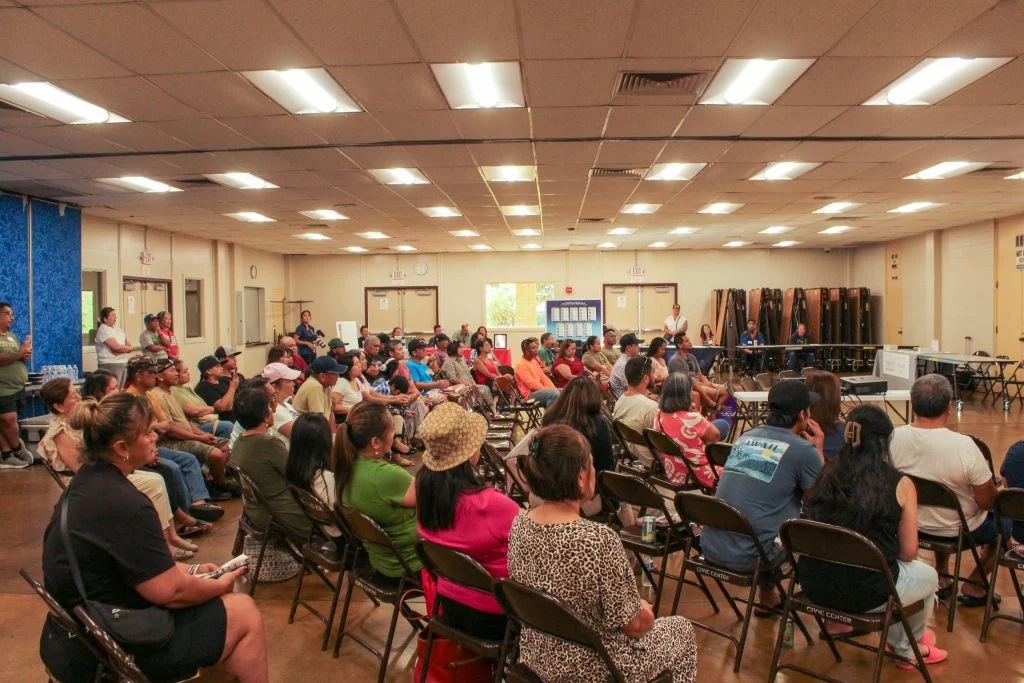
The County of Maui will be working with Kaibigan ng Lahaina to do another formal Town Hall to address other needs of the Lahaina Filipino Community. If you have any hesitations or questions, contact Kaibigan ng Lahaina directly for support and translation services. If you are interested in volunteering and supporting Kaibigan ng Lahaina, you may reach them by phone at (803) 999-6761 or email their team directly at info@kaibigannglahaina.org. You can also meet a representative in person at the Lahaina Office of Recovery between the hours of 9 a.m. to 2 p.m. on Mondays, Wednesdays and Fridays.
“The main message that we at Kaibigan ng Lahaina would like to share is you don’t know if you qualify or not until you actually apply,” said Ugale. “Entering your information into the database may be the best thing to do even in the event you don’t qualify. Should another program become available that you do qualify for, you will already be entered in the system.”
“Ho‘okumu Hou programs are more than just resources—they are vital support designed to bridge a gap and provide hope as our community continues to heal and rebuild,” Mayor Bissen said. “For families who qualify, these programs can assist first-time homebuyers, provide funding to rebuild a home lost in the fire, or offer reimbursement for those who have already completed rebuilding. These opportunities reflect our commitment to help all survivors, including Filipino families—many of whom have long been the backbone of our workforce and community life—return home, restore stability, and strengthen the sense of ‘ohana that is at the heart of our recovery.”

Assistant Editor Alfredo G. Evangelista is a graduate of Maui High School (1976), the University of Southern California (1980), and the University of California at Los Angeles School of Law (1983). He is a sole practitioner at Law Offices of Alfredo Evangelista, A Limited Liability Law Company, concentrating in estate planning, business start-up and consultation and nonprofit corporations. He has been practicing law for 41 years (since 1983) and returned home in 2010 to be with his family and to marry his high school sweetheart, the former Basilia Tumacder Idica.