
War In Iran
Alfredo G. Evangelista | Assistant Editor
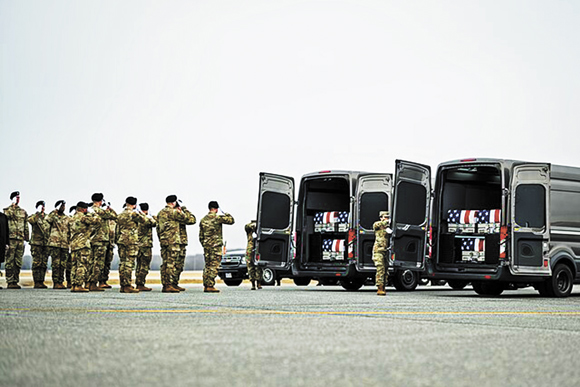
Thirteen U.S. armed forces killed—six in a drone strike in Kuwait, six in a refueling aircraft crash in Iran, and one at Prince Sultan Air Base in Saudi Arabia, and as many as three hundred wounded. So far.
Iran’s Supreme Leader Ayatollah Ali Khamenei killed in an early salvo. (His son Mojtaba Hosseini Khamenei was later elected to replace him.) Other Iranian officials killed included Ali Larijani (Iran’s top security official), Mohammad Pakpour (the Islamic Revolutionary Guard Corps Commander in Chief), Majid Khademi (the Islamic Revolutionary Guard Corps Intelligence Chief), Abodolrahim Mousavi (the Iranian Armed Forces Chief-of-Staff) and Aziz Nasirzadeh (the Defense Minister).
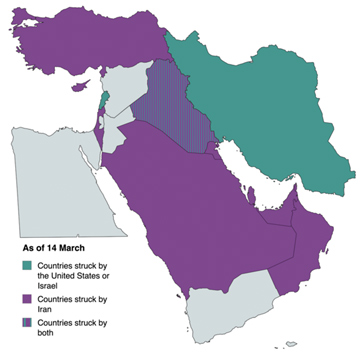
U.S. military sites in Kuwait, Qatar and the United Arab Emirates were attacked by Iran using drones and missiles.
U.S. embassies in Kuwait City and Riyadh were also struck.
The U.S. and Israel targeted a variety of locations including Iran’s capitol Tehran, Chabahar, Isfahan, Karaj, Kermanshah, Minab, Qom, Shiraz and Urmia.
The Strait of Hormuz—which is between the Gulf of Oman and the Persian Gulf—closed by Iran using fast attack boats, a variety of drones, electronic communications jamming, and mining sections of the waterway. The result—global crude oil prices moving above $100 a barrel as a fifth of the world’s oil and other commodities (including fertilizer ingredients) regularly passed through the Strait of Hormuz. Commentators believe the lack of fertilizer will lead to an increase in the price of groceries.
Locally, gas prices moved above the five-dollar mark. (On March 19, AAA Hawai‘i reported gas prices in Kahului averaged $5.14, an increase of 29 cents from the previous week and 62 cents higher than a year ago.)
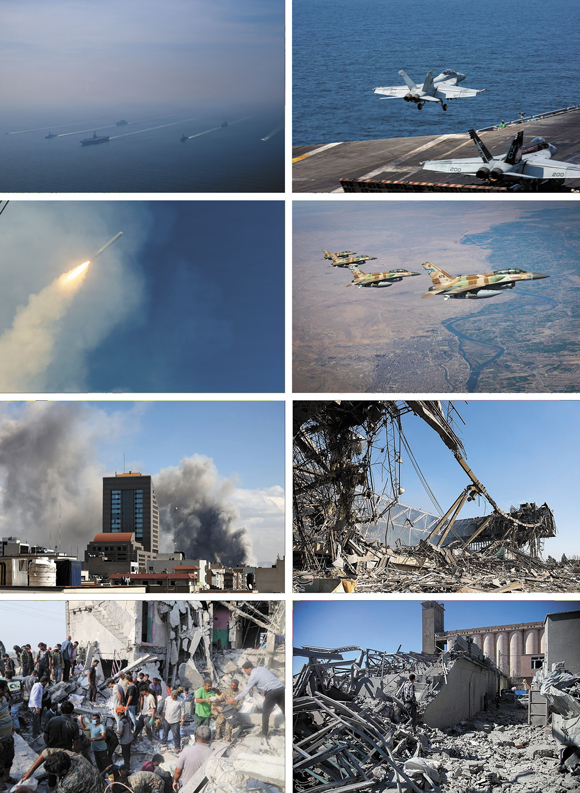
On February 28, the U.S. and Israel, without their European and other allies, launched attacks on Iran. Since beginning his second term, President Donald J. Trump, has been pressing Iran to stop its nuclear program. (Previous presidents had declined to join Israel in any direct military action against Iran.)
During Trump’s first term, the United States had withdrawn from the Joint Comprehensive Plan of Action (JCPOA), a nuclear pact the Obama administration had negotiated with Iran and signed by the five permanent members of the United Nations Security Council—the United Kingdom, France, China, Russia and the United States—as well as Germany.
The Trump administration dubbed the Feb. 28 attack “Operation Epic Fury.”
To date, the U.S. military has expended billions of dollars and used a considerable number of expensive missiles and ordnance in both attacks and in defending against low-cost Iranian drones and munitions. Experts estimate the United States spent $11 billion to $16 billion in the initial weeks of conflict, as well as depleting munitions stockpiles.
In Washington, D.C., Hawai‘i’s Congressional delegation—all Democrats—quickly denounced the war.
“This is a war of choice and a mistake that knowingly risks the lives of U.S. service members and people in the region in the name of regime change. Had President Trump stuck to negotiations or not exited the JCPOA, this could have been avoided,” said senior U.S. Senator Brian Schatz. “The administration must de-escalate immediately. Congress needs to vote and make clear: we will not sign off on another needless war or repeat the deadly mistakes of the past.”
Schatz is a member of the Senate Foreign Relations Committee.
Schatz’ colleague in the Senate, Mazie Hirono, echoed his sentiments. “The President’s unilateral decision to strike Iran for purposes of regime change is a clear violation of the Constitution, which gives Congress, not the President, the sole power to declare war.
What’s more, this President has not articulated a clear strategy for what comes next. I fear that he is recklessly putting the lives of our servicemembers and personnel in the region at risk,” said Senator Hirono. “Today, my thoughts are with American service-members and personnel and their loved ones, as we work to ensure their safety and avoid a broader conflict. With President Trump dragging our country toward yet another endless war in the Middle East, it’s critical that Congress immediately votes on Senator [Tim] Kaine’s War Power Resolution to reassert our constitutional authority and prevent further escalation.”
Hirono is a senior member of the Senate Armed Services Committee.
Congresswoman Jill Tokuda, whose district includes Maui County, also called for a vote. “This morning, Americans woke to the news that our nation launched large-scale military strikes on Iran. In starting this conflict, President Trump neither sought authorization from Congress nor presented the American people with evidence of an imminent threat that would justify bypassing it. The Constitution is clear: the power to take this nation to war does not rest with one person alone. Instead, we are left with the President’s own acknowledgement that our service members may die in this conflict as he calls for regime change in Iran.
There is no question that the brutal Iranian regime has sponsored terrorism against our country and brutally repressed its own people. But every American, especially those with loved ones serving in our military, must ask whether this President has sufficiently justified sending our troops into battle and whether he has laid out a strategy and plan that will guide this conflict toward a defined and achievable end. President Trump has failed on both fronts. He has not demonstrated an imminent threat to justify this conflict, nor has he laid out how and when this conflict will end. The human toll abroad and the economic pain at home should never be the price Americans pay for one man’s war. We deserve better than this.”
Congressman Ed Case issued the following statement: “Our Constitution and laws say that a President cannot take our country to war without Congressional authorization unless there’s an imminent threat to our country and then only for a limited period subject to Congressional approval. History teaches us that the grave risks and consequences of war are too great to allow any President to ignore these foundational checks and balances and act unilaterally. Iran cannot be allowed to have nuclear weapons and the means to deliver them against us, and so there may be circumstances under which war would be our only option. But as there has been no demonstration of an imminent threat to our country, this action is not authorized and that cannot be ignored. The President must fully explain to Congress and the American people the imminent threat we face justifying this action and the specific case for war. Congress must reconvene now to obtain all of the facts and vote to continue or end this military action. We all pray for our service-members in harm’s way and their families and for the innocent lives that are being lost and shattered.”
Case is a member of the House Appropriations Committee’s Subcommittees on Defense and Homeland Security.
Tokuda’s and Case’s statements highlight the legal concerns about Trump’s war. While Trump is the Commander in Chief under Article II, Section 2 of the United States Constitution, the Constitution also limits his authority regarding war. The Article One branch, the U.S. Congress holds the Constitutional authority under Article I, Section 8, to declare war and fund military operations. The President, head of the Article Two branch, can only act against an attack or when there is an imminent attack. The 1973 War Powers Resolution restricts a president’s actions to sixty days unless Congress gives its approval.
So far, the Democrats and other members of Congress have failed to rein in Trump.
On March 4, the U.S. Senate by a vote of 47–53, failed to halt Trump’s war against Iran.
The next day, a resolution to direct Trump to remove U.S. forces from Iran failed in the U.S. House by a 212–219 vote.
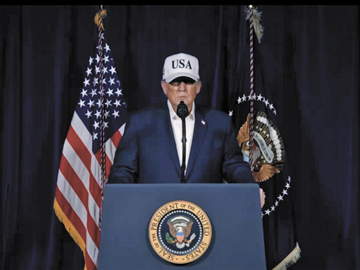
Trump’s initial explanation and subsequent remarks about war goals rambled.
Our objective is to defend the American people by eliminating imminent threats from the Iranian regime. A vicious group of very hard, terrible people. Its menacing activities directly endanger the United States, our troops, our bases overseas, and our allies throughout the world. …
Iran is the world’s number one state sponsor of terror, and just recently killed tens of thousands of its own citizens on the street as they protested. It has always been the policy of the United States, in particular my administration, that this terrorist regime can never have a nuclear weapon. I’ll say it again, they can never have a nuclear weapon. That is why in Operation Midnight Hammer last June, we obliterated the regime’s nuclear program at Fordo, Natanz and Isfahan. After that attack, we warned them never to resume their malicious pursuit of nuclear weapons, and we sought repeatedly to make a deal. We tried. They wanted to do it. They didn’t want to do it. Again they wanted to do it. They didn’t want to do it. They didn’t know what was happening. They just wanted to practice evil. But Iran refused, just as it has for decades and decades.
They’ve rejected every opportunity to renounce their nuclear ambitions, and we can’t take it anymore. …
For these reasons, the United States military is undertaking a massive and ongoing operation to prevent this very wicked, radical dictatorship from threatening America and our core national security interests. We’re going to destroy their missiles and raze their missile industry to the ground. It will be totally again obliterated. We’re going to annihilate their navy. We’re going to ensure that the region’s terrorist proxies can no longer destabilize the region or the world and attack our forces, and no longer use their IEDs, or roadside bombs as they are sometimes called, to so gravely wound and kill thousands and thousands of people, including many Americans. And we will ensure that Iran does not obtain a nuclear weapon. It’s a very simple message. They will never have a nuclear weapon.
This regime will soon learn that no one should challenge the strength and might of the United States Armed Forces. I built and rebuilt our military in my first administration and there is no military on earth even close to its power, strength or sophistication. My administration is taking every possible step to minimize the risk to U.S. personnel in the region. Even so, and I do not make this statement lightly, the Iranian regime seeks to kill. The lives of courageous American heroes may be lost, and we may have casualties. That often happens in war. But we’re doing this not for now. We’re doing this for the future. …
To the members of the Islamic Revolutionary Guard, the armed forces and all of the police, I say tonight that you must lay down your weapons and have complete immunity. Or in the alternative, face certain death. So, lay down your arms. You will be treated fairly with total immunity, or you will face certain death. Finally, to the great proud people of Iran, I say tonight that the hour of your freedom is at hand. Stay sheltered. Don’t leave your home. It’s very dangerous outside. Bombs will be dropping everywhere.
When we are finished, take over your government. It will be yours to take. This will be probably your only chance for generations.
For many years, you have asked for America’s help. But you never got it. No president was willing to do what I am willing to do tonight. Now you have a president who is giving you what you want. So let’s see how you respond. America is backing you with overwhelming strength and devastating force. Now is the time to seize control of your destiny, and to unleash the prosperous and glorious future that is close within your reach. This is the moment for action. Do not let it pass.
Almost immediately, however, the Trump administration issued differing reasons for the war. On March 2, Secretary of Defense Pete Hegseth said the strike was to end a 47-year war. Later, Hegseth said the strike was because Iran refused to negotiate. Also on March 2, Secretary of State Marco Rubio said the war was in response to Israel planning to strike. But that was contradicted by Trump’s own statement that it had nothing to do with Israel planning to strike.
Israel’s official explanation also differed from the Trump’s administration, calling it a “preemptive strike.”
But there was no evidence from the United States or Israel of any Iranian plans to attack.
With the Republicans narrowly controlling both chambers of Congress, it appears any effort to stop Trump’s Iran War will fail unless the GOP members have a change of heart. In the meantime, America can look forward to continued higher gas prices, travel disruption, increased inflation impacts on the economy, more American casualties and unrest in the Middle East and the rest of the world.

Assistant Editor Alfredo G. Evangelista majored in Political Science at the University of Southern California before receiving his law degree.